See Record360 at Bauma 2025: April 7-13, Munich, Booth C4-719

Archives for November 2020

How to make your rental contracts legally bulletproof

Renting assets such as heavy equipment and trucks come with significant risks. Any theft or damages to your rented assets can lead to expensive liabilities and hurt your bottom line big time.

That is why it’s crucial to have a solid rental contract in place to protect your business and manage risks, including equipment malfunctions leading to contractor lawsuits and contract breaches that leave you with hefty legal bills.

In this guide, we’ll cover several tips on making your equipment leasing and rental contract legally bulletproof and the terms and conditions you should build into your agreement.

1. Know your implied legal duties

Before getting into the nitty-gritty of what makes a solid leasing agreement, you’ll need to know your responsibilities as the lessor under the rental contract.

Duty to inspect

Check the equipment when you first get it from the manufacturer and when it comes back from the customer to ensure it’s safe and reasonably free of obvious defects.

Duty to instruct

Inform customers about the proper and safe use, storage, maintenance, transfer, repair (if required) of the equipment.

Duty to warn

Warn your customers of the potential dangers of expected misuse of the equipment, such as unloading an excavator from a flatbed without an appropriate ramp, which might cause it to fall and get damaged.

Most equipment manufacturers provide instructions and warnings on safe and proper machinery handling. Include a provision in your contract limiting your customers’ usage to the manufacturer’s intended use.

This way, you won’t be held liable if the equipment gets damaged because of the customer’s misuse of the machinery.

Also, include a contract requirement for customers to stop using the equipment in case of malfunctions and accidents and to notify you immediately to prevent further damage.

While all these can help protect your business from several potential legal issues, you can’t avoid all liabilities and might still get sued for anything that can go wrong.

Setting up legal protections through bulletproof contracts, having a good process of getting signatures, and establishing proper documentation is crucial to lower your legal costs in case of disputes.

The more comprehensive these legal protections are, the more likely you’ll discourage other parties from filing claims and lower the amount you have to pay in case of a settlement.

2. Increase legal protection through your equipment rental contract

A rental contract touches on many areas of leasing exposures, such as equipment damages, class action lawsuits, and personal injury claims. If your agreement doesn’t cover these risks, you leave your business open to a long list of potential liabilities.

That is why you need to ensure your contract includes all the necessary information and build terms and conditions, rights, and remedies into your leasing agreement to protect your business.

An excellent way to increase your legal protection through your rental contract is to have a Master Services Agreement (MSA) with your customers.

An MSA sets the terms for any additional rental contracts that you sign with your customers in the future.

This way, when you need to exchange or add new pieces of equipment to the contract or do multiple business arrangements with existing customers, you won’t need to create a revised agreement and get it signed every single time.

An MSA provides your business some umbrella protection if you don’t get a signature or don’t have a rental contract for some reason since the master lease will be the assumed terms of your equipment rental agreement.

Push for master agreements, particularly if you’re doing repeat business or leasing $50,000 to $200,000 worth of equipment as a first line of legal protection against potential expensive liabilities.

At a minimum, if you’re doing daily rental contracts with new customers, ensure your agreement includes a provision that says, “This contract and these contract terms will apply to all future rented items and agreements with the lessor,” but your safest bet is to go for an MSA.

Master agreements vs. Individual rental contracts

Daily rental contracts are single page front and back agreements commonly used for one-off rentals of one or a couple of equipment separately.

An MSA is a legal document that states the terms of the relationship between the lessor and lessee going forward. It contains the terms both parties agreed to, negotiated, and signed off on once.

So if your customer rents your equipment, your company sends a purchase order to your client and processes the release and delivery of the equipment. The customer then pays for the rental amount and accompanying fees according to the payment terms in the MSA.

With this, you won’t need to renegotiate the contract terms and conditions for each equipment or revise your existing contract since customers are reaffirming the master agreement every time they rent your machinery.

This eliminates a key bottleneck of the transaction process for both you and your customers while ensuring your business has the legal protection measures in place through your rental contract.

A vital aspect of this process is documenting the condition of the equipment when you released it, when it arrived at the job site, and when it’s returned to you as this provides evidence of the charges to your customer.

The better you document the in and out process of your equipment, the more evidence you have, and the more likely you’ll get paid and have solid evidence in case of a dispute.

3. Use the right technology to obtain authorized contract signatures

Getting signatures on your agreement terms can be challenging with the endless back and forth that comes with paper contracts. You’ll also need to make sure the person signing the contract is authorized to sign on behalf of the company or lessee.

Use verification technology including geolocation, time stamps, signatory Internet Protocol (IP) addresses, Public Key Infrastructure (PKI), and digital signature apps to help validate contract e-signatures and signatories easily and in real-time.

With this technology, you get your legal documents to someone you’re sure has the authority to sign, maybe the company owner or president, and ensure the signature is valid and will hold up in court.

Building all this technology into your process makes obtaining and verifying signatures more reliable and efficient than pen and ink rental agreements.

4. Implement a Damage Waiver policy

When you sell damage waivers, you’re essentially selling a waiver of your claims to collect physical damage to your equipment when it comes back from a renter. This usually comes in an additional 10% or 15% of your rental fee.

Damage waivers allow you to offset your company’s long-term costs associated with equipment repairs and replacements with the percentage you get from your damage waiver sales.

However, you need to implement it properly and review your current damage waiver program to resolve potential disputes and avoid lawsuits by considering these tips.

  • Include a separate line item for the Damage Waiver fee charge on the front of your equipment rental contract.
  • Add a statement that says, “Damage Waiver is optional” on both the front and back portion of your rental contract. This shows customers that they can opt out of and not pay for the waiver.
  • Include a Damage Waiver provision on the back portion of your rental contract or in a separate addendum. Use simple language and as little legal jargon as possible so customers understand the terms easily.
  • Use print large enough for customers to read and include language in your rental contract that states, “A larger-font version of these Damage Waiver terms and conditions is available on request.”
  • Provide a separate Damage Waiver guide or Addendum to customers who purchase the waiver to ensure they understand its terms, policies, and coverage.
  • Train your counter employees on the value of Damage Waivers and ensure they can communicate the savings on costs and time the waiver provides your customers.

Implementing a Damage Waiver policy can get tricky, but as long as you know how best to administer your program, you’ll gain its benefits, offer its value to your customers, and avoid lawsuits.

Additionally, check with your insurance company first for coverage, or you could be in for a terrible surprise when you end up with badly damaged equipment and your insurance policy doesn’t cover it.

Make your contracts legally effective now

Creating a solid rental contract helps you protect and legally represent your business effectively from equipment leasing risks.

It also makes your equipment rental processes more efficient since all the terms and conditions are clear-cut from the get-go, preparing you for legal issues, lowering your legal fees, and reducing lawsuits.

Interested in learning more about Record360? Schedule a demonstration today.
Winning rental businesses are transforming their business with inspection management software

We’ve worked with hundreds of equipment rental operators across the country and the most successful operators we’ve seen follow a simple winning strategy. Three core pillars matter most: 1) maintain quality assets at reasonable prices; 2) develop loyal customer relationships and 3) hire great talent.


1) Maintain quality assets

The best operators maintain high quality and good looking assets at reasonable prices. The way your fleet looks matters more to customers than it should. They notice scratched paint jobs, dirty equipment and dings. These issues might seem cosmetic. But your customers assume that if the asset appears poorly maintained, then the asset quality is poor. Over time, your brand will become associated with low quality assets, which will drive away your most valuable customers.

At the same time, you need to maintain quality, and the perception of quality, at reasonable prices. You can’t always have the newest fleet. If your fleet age is too young, your fleet costs will be too high. Similarly, if your equipment is always getting damaged and you can’t collect on that damage, your unrecoverable maintenance costs will be too high. The key is to maintain good looking, quality assets at reasonable prices.

2) Build loyal customer relationships

You must build loyal relationships with customers to win. It’s always easier to expand an existing customer relationship than it is to develop a new one. You’ve already won your customer’s trust. You already know how to work with them. Your sales and service teams are already calling on them. Both you and your customer have already made the investment to put the groundwork in place. 

As a result, the highest return on your team’s time will be from expanding your share of wallet with your best customers. Expanding your existing customer base relies on building relationships of trust and accountability so both you and your customer are confident investing further in the relationship.

3) Hire great talent

Hiring and cultivating great talent is critical to outperforming in equipment rental. Hiring and retaining talent is becoming increasingly important given the shortage of skilled technicians, but the principle applies to all functions.

To hire and retain the best talent, you need to build a strong culture that attracts the best talent and you need to build processes and provide tools that make it easier for your employees to be productive so they can flourish in their roles.

Traditional inspection processes threaten operator’s ability to win

Traditional inspections processes threaten the rental operators ability to execute a winning rental strategy. In the old world, equipment rental inspections were done with cumbersome processes and technology like pen and paper, carbon copies forms or using digital cameras and SD cards to upload to shared drives. These poor processes result in poor condition documentation, which makes it hard to charge customers when damage occurs without threatening the relationship you’ve built with them.

Poor documentation directly impacts the three pillars of a winning rental strategy. Equipment damage hurts your equipment quality and brand and increases your fleet costs which compresses margins. Charging customers for damage without good documentation erodes trust and can lead to fights with customers which harms the relationship. Forcing your employees to use clunky processes to do inspection is frustrating for your hard won talent.

Inspection management software is transforming rental

The best operators are transforming their equipment inspection process by implementing modern inspection management software like Record360. Modern inspection management software is cloud-based, includes high quality photo and video, and provides condition records that are easily searchable and shareable. It’s helping the strongest operators execute a winning rental strategy.

First, they’re able to maintain quality assets and a brand they’re proud of.  Renters who identify new damage through careful inspections can more easily charge customers for the damage. There’s simply less to argue about. Using these chargebacks to repair the equipment keeps the fleet in quality condition.

Secondly, they’re able to build customer relationships based on trust and accountability. Sending rental inspections to your customers using a platform like Record360 builds confidence with your customers that you won’t charge them for damage they don’t cause. They’ll feel like they’re treated fairly and trust is built. It also incentives your customer to take care of the equipment because they know they’ll be charged if damage does occur.

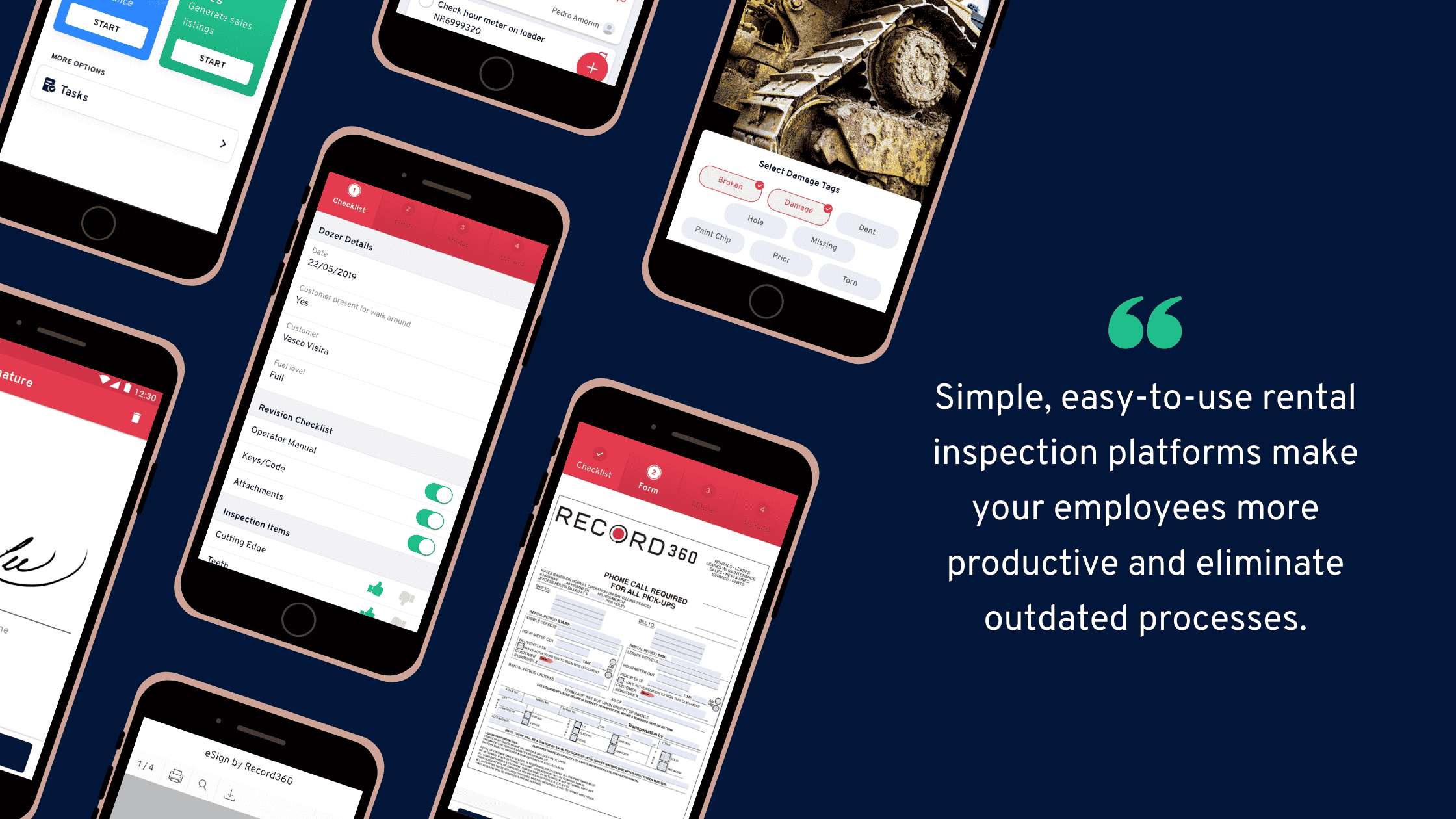
Finally, they’re able to provide their hard won employees with simple and easy to use inspection tools that make their jobs easier. Clunky software or hard-to-manage paper processes will frustrate your most valuable employees. Simple, easy-to-use rental inspection platforms make them more productive and eliminate outdated processes.

Inspection management software can increase damage collections by $100K+ per year

A great example of inspection management software supporting a winning rental strategy is the incredible rental growth story of Komatsu West.

Komatsu West has 11 locations and has grown their rental revenue from $5M to $60M – an astonishing achievement. Implementing Record360 helped them on that journey. By using Record360, they’ve not only been able to keep their machines in better condition, but they’ve also been able to increase their damage chargebacks by over $100k per year. Their rapid rental growth can also be attributed to a loyal customer base that knows they’ll be treated fairly and will never being charged for damage they didn’t cause. On top of this, their employees love the simplicity of documenting a rental with a simple checklist and video on an iPad or iPhone. 

According to Joel Cook, the EVP of Mining, Construction and Rental Sales, “Record360 has saved us hundreds of thousands of dollars. It was very easy to implement, everybody was excited to have it, and I never heard any complaints from employees.”

If you’d like to hear the full story, check out our full interview with Joel Cook here.

Investing in inspection management software is key to executing a winning strategy

Equipment rental inspections are evolving. The strongest operators are investing in modern inspection software like Record360 to execute a winning strategy. Times have changed in rental, and those that are adapting are winning.

Interested in learning more about Record360? Schedule a demonstration today.

How to use data to drive rental sales growth


Heavy equipment rental consultant, Mets Kramer, joined Record360’s CEO, Jesse Buckingham, for an in-depth conversation on using data to drive predictable rental sales growth. They also discussed how to grow rental sales by becoming a trusted advisor to your customers, as well as how to leverage technology (e.g., CRMs, Record360) to build loyal customers. Read on below for a summary of the key takeaways from our webinar, A data driven approach to rental sales growth.

Highlights

  • What are the benefits of becoming a trusted advisor to my customers? (8m 45s)
  • How can I leverage technology to remember key information about customers? (12m 40s)
  • How do I develop systems and processes to scale my rental business? (22m 34s)
  • What sort of data should I be tracking on my customers and their equipment? (25m 56s)
  • How do I get comfortable suggesting to my customers they should buy versus rent? (30m 30s)
  • Who should be in charge of collecting, and tracking, key customer data? (39m 27s)
  • How can I know when I’m buying software that my team will love and use? (45m 36s)


Building relationships of trust and loyalty with customers doesn’t stop with knowing their names, likes, and dislikes. As Mets put it, “you need to know your customers deeply to give them good advice.” Those in the rental industry know that they’re in the business of relationships and giving advice. To give the best advice you have to have a complete picture of your customer. As Jesse put it, “The core insight here is about putting yourself in your customers’ shoes so that you understand the context they’re operating in…that allows you to speak from a place where you know their interests and you’re no longer just the guy with the equipment you want to sell.” Having a deep understanding of the equipment your customers use, how they use it, and what they want to achieve are all prerequisites to becoming a trusted advisor.

Becoming a trusted advisor requires you to have lots of information about your customers, and their equipment, at your fingertips. This means you need technology (e.g., CRM, Record360) to overcome the brain’s limited capacity to remember things. Mets shared a story where “a young service supervisor would take calls all day, and I asked him ‘How do you remember to call that guy back later?’” The supervisor said to Mets, “Oh, well I remember everything.” Later that day the same customer called the supervisor, after not hearing back from him. The supervisor immediately remembered the customer, their issue, and the fact that he was supposed to call. The supervisor apologized for not calling back and resolved the customer’s issue. This is not an ideal customer experience. As Mets puts it, “A lot of customer information is tied up in peoples’ heads and peoples’ heads are not great at remembering everything.” To replace the fallible human brain with something more reliable, most rental shops and dealerships have implemented a Customer Relationship Management (CRM) system, like Salesforce. This is used to house critical customer information. When it comes to remembering things about a customer’s equipment, rental operators rely on an Inspection Management System, like Record360. Remembering what pre-existing damage was on a specific unit before it went out is difficult. Taking photos, video, and completing a digital checklist on a mobile device is simple and reliable. Technology enables you to become the trusted advisor your customers will rely on.

Developing strong systems and processes, like the ones mentioned above, are crucial when building a scalable rental sales team. Mets is a firm believer that, “you can’t build a growing organization around one person…if you want to grow your business you need to be repeatable and scalable.” Put another way, how can you take the best practices from your best employees and make them repeatable by everyone? Mets goes on to say that, “the entire point of putting information, systems, and tools in place for people is to replicate the success you’ve had.” If you’re an owner or manager with a key employee or two, you should be looking for ways to develop systems which replicate that employee’s success across your entire organization. That allows your business to be repeatable, and therefore, scalable.

The core insight here is about putting yourself in your customers’ shoes so that you understand the context they’re operating in…that allows you to speak from a place where you know their interests, and you’re no longer just the guy with the equipment you want to sell.

Now, what sort of data points should be tracking? For Mets, he always begins with understanding the entire ecosystem of the customer’s business. What is the job they’re trying to accomplish? What equipment do they have in their fleet? Once you understand their fleet and objective, you can apply that information to suggesting the best equipment to get their job done. Mets has found that salespeople can oftentimes just ask the customer for their fleet list. He says, “they’ll give it to you because they’ll assume you’re going to do something useful with it,” which you will. After collecting fleet data, Mets recommends tracking the following: residual values on the equipment, operating cost per hour, and disposition planning, among other things. Armed with this data, you can surprise your customers with expert insights on which machines they should be buying and which ones they should be renting. Your customers will appreciate you looking out for their best interest and will, in turn, become more loyal to your business. If you’re not tracking these pieces of data right now, then you’re leaving customer loyalty, and money, on the table.

This data will not only help your bottom line, but it will also help your salespeople. It positions your salespeople as experts and thought partners, as opposed to the person the customer calls when they need a new piece of equipment. You might have thought that focusing on data would erode the ability to develop strong relationships, but the opposite is true. Having this data on your customers allows you to provide valuable insights to your customers, which helps build trust, loyalty, and the relationship.

To wrap up, Mets discussed how to successfully implement new systems such as a CRM or Record360. I’m sure many people reading this have struggled to roll out a new piece of software to their team. How do you get buy in? How do you make the right choice when buying software? From Mets’ perspective it’s critical that you “bring your salespeople to the table in the evaluation phase.” You can make the final decision, though you should involve your sales team in the buying process. “If it attracts your salespeople then you’re onto a winning tool,” said Mets. Additionally, you need to have a mobile version of whatever tool (i.e., piece of software) you’re buying. “You’re out of the game,” if your software is not mobile.

In sum, Mets’ playbook for using data to drive rental sales growth hinges on how you use data to become a trusted advisor. First, you must choose a system, with your sales team, to house that key data. Next, you must curate that data over time (e.g., residuals on equipment, operating cost per hour) to produce expert insights for your customers. Finally, you need to bring these insights to your customers to help inform their decision making. By helping them make informed decisions with data, you’ve built trust, loyalty, and cleared the runway for future sales opportunities with that customer.

Interested in learning more about Record360? Schedule a demonstration today.